
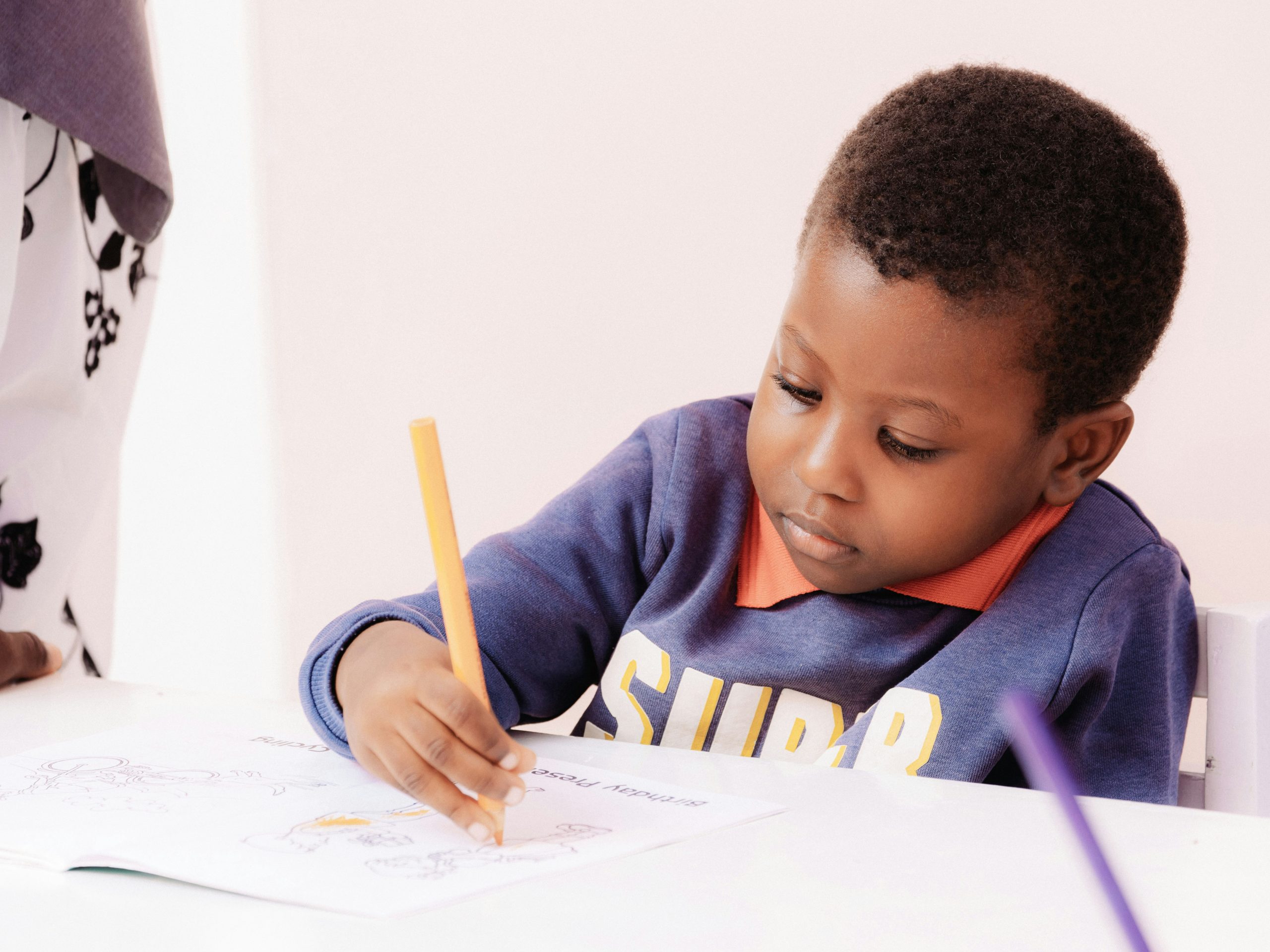
Mummy Deolu is holding a cane, arms akimbo, brows creased together. Wondering why her five-year-old just can’t get 5+5.
They’re in the kitchen, and Deolu is seated on a stool while his mum is cooking dinner. They’ve been at 5+5 for almost thirty minutes, and he just can’t seem to get it.
‘Deolu, please focus,’ she says in a tight voice.
But Deolu can’t focus; he’s tapping his leg on the chair and staring into space. His mum taps him lightly with the cane and yells, “Deolu, don’t be lazy and use that brain of yours.”
In case you’re wondering, Deolu isn’t lazy – and neither is your child. They just learn differently.
So what’s really happening when a child like Deolu can’t seem to ‘focus’? The answer often lies in understanding learning styles.
The VARK model was created by a New Zealand teacher and educational theorist, Neil Fleming, in 1987. He basically divided the different ways of learning into:
- Visual learning style
- Auditory learning style
- Reading/writing learning style
- Kinesthetic learning style
These styles, popularly called the VARK model, are the most common type of learning classification.
Visual learners: They understand information best when they can see it. They are naturally drawn to pictures, diagrams, demonstrations, and other visual cues. For these children, pages filled with dense text may feel overwhelming, while illustrated materials or practical demonstrations can bring concepts to life.
Rather than assuming resistance, parents may need to consider whether the teaching method matches the child’s learning preference.
Auditory learners: They grasp information more effectively when they hear it. Discussions, verbal explanations, storytelling, and even music can significantly improve their understanding.
A child who prefers reading aloud, asking questions, or turning information into songs is not being unserious — they are engaging with the material in a way their brain understands best. Traditional memorisation alone may not be the most effective strategy for them.
Reading/Writing Learners: This learning style aligns most closely with conventional academic structures. These learners respond well to written words, textbooks, note-taking, and structured study sessions. They are often comfortable sitting for long periods and processing information through reading and writing.
Because schools are largely designed around this style, it is often — and mistakenly — seen as the “ideal” way to learn.
Kinesthetic Learners: Kinesthetic learners thrive through movement, participation, and hands-on experience. They are frequently described as “restless,” not because they lack discipline, but because their brains engage more fully when their bodies are involved.
Experiments, building projects, role-playing, and practical applications help transform abstract ideas into tangible understanding. For these children, learning is not passive; it is active.
Deolu, tapping his leg and staring into space? He was likely a kinesthetic learner, needing to move and touch objects to understand that 5 blocks plus 5 blocks equals 10 blocks.
Now, no one style is better than the other. They are all unique in their own way. So, if your child isn’t learning by sitting down at their desk and reading their books, they’re not lazy. It may just mean that they need to go outside and see what you’re saying, or they need it to be turned into a song, or they want to practice what their books are saying. And that’s perfectly fine.