
- November 5, 2026
- Kidemia Community
- 0
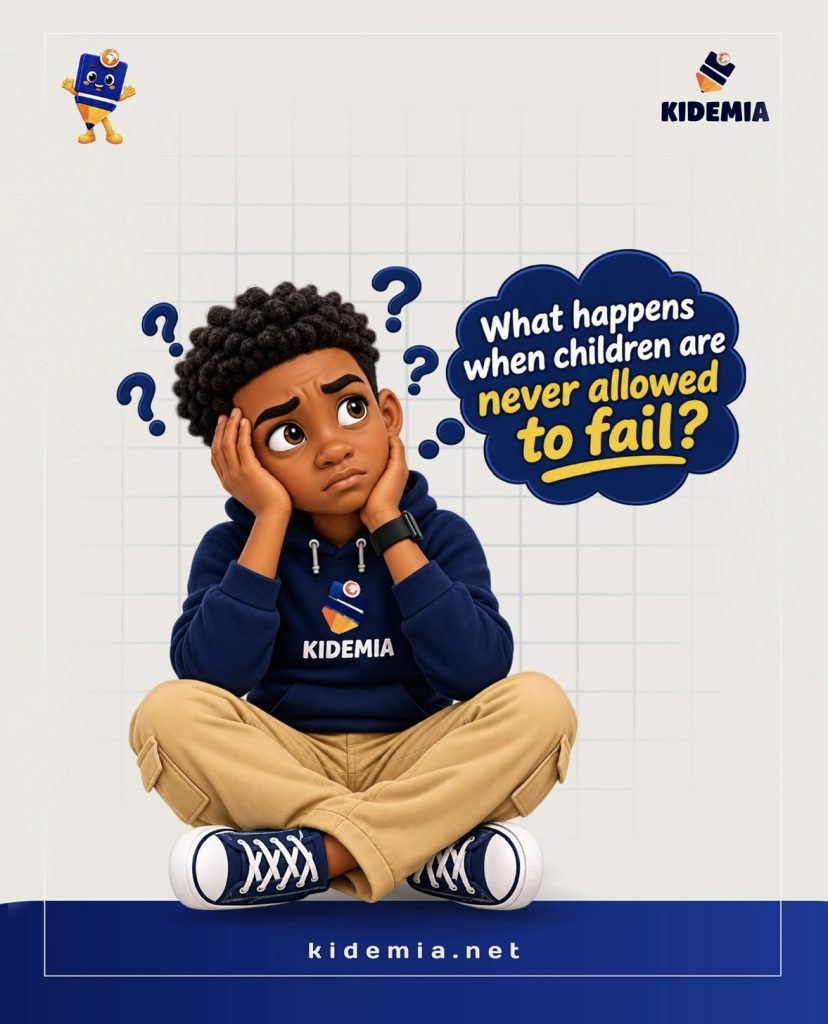
What Happens When Children Are Never Allowed to Fail?
Every parent wants their child to succeed.
That is natural.
We want children to feel confident, perform well at school, make good decisions and avoid unnecessary pain.
But there is a difference between helping children succeed and trying to eliminate every opportunity for failure.
Children need protection from serious harm. They also need opportunities to experience manageable challenges, make mistakes and discover that they can recover from them.
Failure Is Information
A failed experiment tells a child something didn’t work.
A difficult maths problem tells them they may need another approach.
Losing a competition teaches them that preparation, ability and outcomes do not always align perfectly.
A friendship disagreement can teach them about communication and boundaries.
Failure does not automatically produce resilience. Children need support in interpreting it.
But when adults respond to every mistake by immediately fixing the problem, children can miss the opportunity to learn what the mistake is trying to teach them.
The Difference Between Support and Rescue
Imagine a child struggling with a school project.
A parent could complete the difficult part for them, ensuring the project is perfect.
Or the parent could ask questions:
-
What part are you finding difficult?
-
What have you tried?
-
What could you try differently?
The second approach may take longer.
But it gives the child an opportunity to practise problem-solving.
This does not mean adults should stand back when children genuinely need help. Support remains important. The goal is to help children develop the ability to handle challenges rather than making sure they never encounter one.
Children Need Room to Try
This is especially important as children grow up in an environment where achievement can be highly visible.
Grades, certificates, competitions and accomplishments can make childhood feel like a constant performance.
But children also need space to attempt things simply because they are interested.
They need permission to draw something badly, build something that falls apart, write a story that isn’t very good yet or try a new activity without immediately needing to excel at it.
Learning happens through experimentation.
And experimentation inevitably includes failure.
Failure Is Not Final
One of the most important lessons children can learn is that a disappointing result does not define their ability or determine what they can achieve.
A low score in a test does not mean a child cannot understand the subject. It may simply reveal topics they haven’t fully grasped or skills that need more attention.
Rather than treating a poor result as the end of the conversation, parents and educators can use it as a starting point.
What happened?
Which areas were difficult?
What can be improved?
What can the child practise differently?
With the right support, consistency and opportunities to try again, children can strengthen their weaker areas and make meaningful progress.
The goal is not to pretend that failure doesn’t matter. It does. But it should not become a permanent label attached to a child’s abilities.
Turning Learning Gaps into Opportunities for Growth
Understanding a child’s learning progress is an important part of helping them improve.
At Kidemia, assessments are designed to provide more than just a score. Each test result helps show how a student is performing in a subject across different topics, highlighting areas where they are doing well and areas that need further development.
This gives parents and educators a clearer picture of what a child understands and where additional support or practice may be needed.
With this insight, children can be encouraged to revisit challenging topics, practise consistently and take on new challenges as they improve.
Over time, these small, consistent efforts can strengthen areas of weakness, build confidence and improve academic performance.
Identifying areas for improvement is only the beginning. Children also need the right tools and opportunities to keep learning, practising and making progress.
Kidemia helps children discover their strengths, identify topics where they need more practice and track their learning progress. With these insights, parents and educators can better understand their performance and encourage them to work on areas that need improvement.
The weekly leaderboard adds another layer of motivation by introducing healthy competition. Children can see how they rank, celebrate their progress and feel encouraged to challenge themselves to do better. Rather than focusing solely on being ahead of others, the goal is to inspire children to keep learning, practising and improving.
Because every test is an opportunity to learn something new, every challenge is a chance to grow, and every setback can be the beginning of better results.
Sometimes, giving children room to fail is not setting them up for failure.
It is preparing them for real life.