
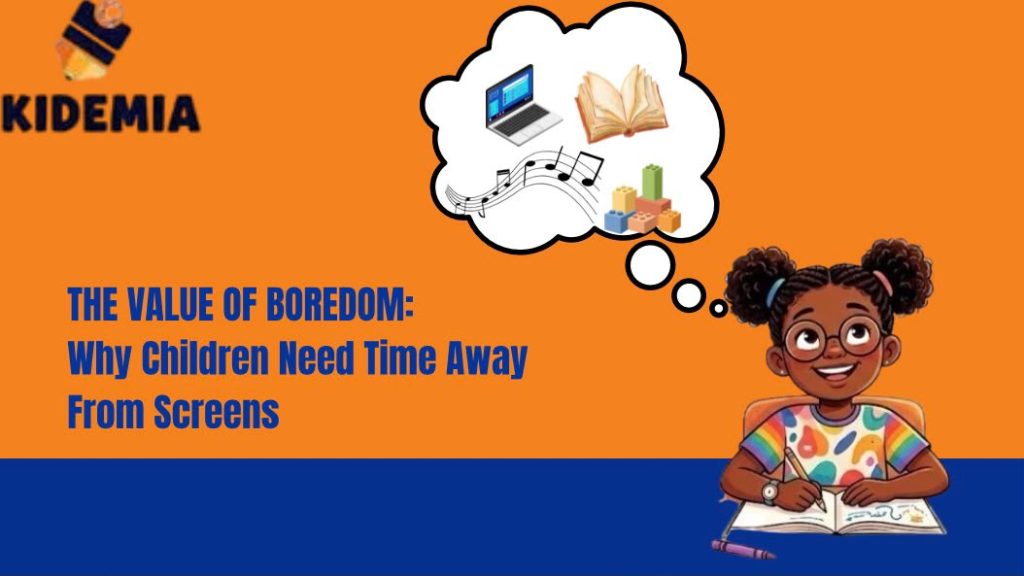
The Value of Boredom: Why Children Need Time Away from Screens
The first week of resumption often comes with a return to early mornings, school runs, homework and the routines that structure a child’s school week. By the weekend, children understandably need time to rest and recover from the demands of school.
For many children, this time also means more opportunities for screen use. Social media, online games, streaming platforms and other forms of digital entertainment can easily become the default way to spend free time once the school week is over.
There is nothing inherently wrong with children enjoying screen time. Technology is an important part of how young people learn, communicate, create and entertain themselves. However, leisure time should not become entirely dependent on screens. Time away from school can also provide children with opportunities to explore their interests, interact with others, develop practical skills and, importantly, learn how to entertain themselves.
One way to create that space is to allow children to experience boredom.
Boredom often has a negative reputation. When children complain that there is “nothing to do”, the immediate response may be to offer an activity, turn on the television or hand them a phone or tablet. Yet having nothing immediately available to occupy their attention can give children an opportunity to think independently and decide what to do for themselves.
This is particularly relevant in an environment where digital entertainment is constantly available. Screens offer immediate stimulation, on-demand entertainment and a steady stream of content designed to hold attention. A child can move from one video to another, start a new game or find something else to watch without having to create an activity of their own.
The question, therefore, is not only how much screen time a child is getting, but also what that screen time is replacing.
An afternoon spent scrolling, gaming or watching videos is an afternoon that cannot simultaneously be spent reading a book, playing outdoors, talking with siblings, practising a hobby, helping with a household task or simply sitting with an idea long enough to develop it. This does not make screen use inherently harmful, but it highlights the importance of considering what children may be missing when screens occupy most of their free time.
Constant access to entertainment can also make ordinary boredom feel more difficult to tolerate. When there is always something available to watch, play or scroll through, children have fewer opportunities to practise finding their own sources of stimulation.
Without constant stimulation, a child may begin to explore possibilities that would otherwise be overlooked. A pile of books might become the beginning of a reading session. Paper and colouring materials might inspire a drawing, comic or story. Building blocks, household objects or discarded packaging could become the materials for an invention. A child might organise a game with siblings, learn a new skill, help with a household task or simply spend time observing and exploring their surroundings.
These activities do not need to be carefully planned or supervised at every stage. In fact, part of the value lies in allowing children to decide what interests them, experiment with ideas and work through the challenge of figuring out what to do next. A child who is bored may need some initial encouragement, but the eventual activity can become something they have chosen and developed independently.
Parents can support this process by making books, art supplies, puzzles, games and other creative materials accessible. They can also suggest broad possibilities without directing every step. Asking a child what they would like to make, learn, investigate or play can encourage them to think beyond the immediate desire for entertainment.
Boredom can also create opportunities for social interaction and practical learning. Children may find ways to cooperate with siblings, invent games with friends, practise a hobby, prepare a simple snack with supervision or participate in household responsibilities. Such experiences can help develop problem-solving skills, confidence and a sense of independence.
At the same time, balance is important. Screens are not the enemy, and removing them entirely is neither necessary nor realistic. Digital tools can support learning, creativity and social connection. Children can use technology to research a question, learn a new skill, create something of their own or connect with people beyond their immediate environment. Responsible technology use is an important part of growing up in an increasingly digital world.
The aim, therefore, is not to replace every hour of screen time with another structured activity. Children also need genuine downtime. They need moments when they are not expected to learn, produce or accomplish anything. The difference is that downtime does not always have to come in the form of digital entertainment.
Children need opportunities to be both consumers and creators. They need time to engage with technology, but they also need time to read, play, imagine, experiment, interact and simply figure things out on their own.
For parents, this may sometimes mean resisting the instinct to immediately solve a child’s boredom. Instead of providing another source of entertainment, allowing children the space to decide what to do can encourage independence and creativity. It may take some time for a child accustomed to constant stimulation to adjust, but that initial discomfort can be part of learning how to occupy their own time.
Boredom does not necessarily need to be avoided. Sometimes, it is the empty space in which a child discovers an idea, a new interest, a new skill or a different way of seeing the world.